Residential tick pressure in the Midlands escalates rapidly from early spring through October due to high heat and atmospheric humidity. Dense vegetation and mature tree canopies in historic neighborhoods like Shandon,…
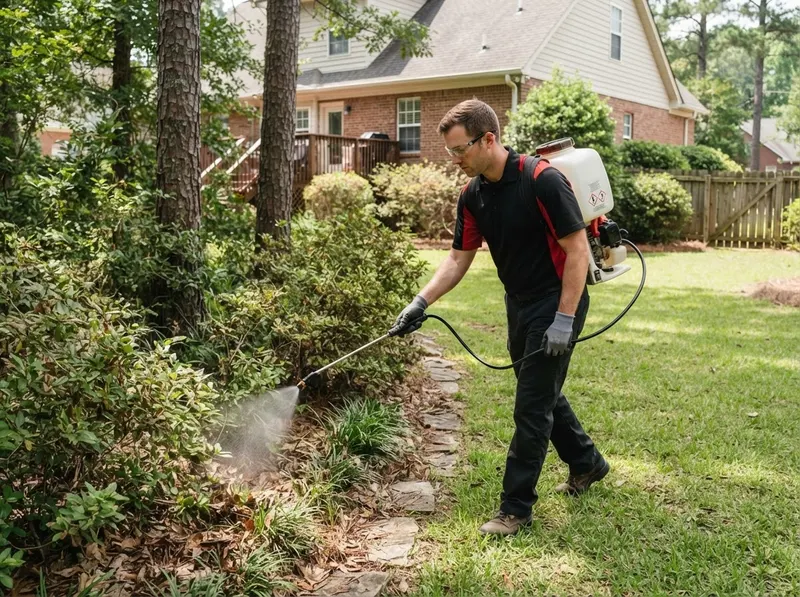
Residential tick pressure in the Midlands escalates rapidly from early spring through October due to high heat and atmospheric humidity. Dense vegetation and mature tree canopies in historic neighborhoods like Shandon, Heathwood, and Elmwood Park create damp ground-level microclimates where ticks thrive out of direct sunlight. While broadcast turf treatments treat broad grass blades, targeted barrier science establishes continuous treated bands specifically where tick host vectors, such as white-tailed deer and rodents, transit into lawns. Property lines adjoining overgrown greenways, such as areas near the Columbia Canal and Riverfront Park or drainage tributaries near Lake Katherine, face constant re-infestation pressure without a residual perimeter line. Applying perimeter barriers prevents blacklegged ticks (Ixodes scapularis) and lone star ticks (Amblyomma americanum) from latching onto pets and residents.
Technicians deploy liquid microencapsulated formulations calibrated according to guidelines from the United States Environmental Protection Agency. The product adheres to organic surfaces, maintaining potency on dense pinestraw, shredded bark mulch, and fallen foliage common across Forest Acres, Rosewood, and Earlewood yards. The barrier targets the transition zone: an 8- to 10-foot-wide swath encompassing low groundcover, ornamental borders, and the first 3 vertical feet of bordering brush, reflecting recommendations established by the Clemson University Cooperative Extension. Because standard broad-spectrum mowing sprays wash away during heavy summer downpours, encapsulated active ingredients remain bonded to plant matter, resisting degradation from Midlands thunderstorms and the prolonged UV exposure common along river valley corridors.
Homeowners selecting between general mosquito fogging and dedicated tick yard barriers must weigh spatial behavior against material coverage. Flying pests inhabit broad leaf undersides high up in shade trees, whereas questing ticks rest within 18 to 36 inches of the soil line on tall grass blades and leaf mulch waiting for a passing host, as documented by the Entomological Society of America. A general airborne mist drifts quickly and deposits minimal product onto dense soil thatch. In contrast, tick barrier defense drives pressurized residual droplets deep into moist organic strata, satisfying standard control benchmarks set by the National Pest Management Association. A standard suburban lot in Cottontown, Melrose Heights, or Old Shandon requires roughly 15 to 30 gallons of finished solution to fully saturate the active transition line, establishing immediate mortality for emerging nymphs and adult females.
Executing decisive perimeter suppression follows a strict operational sequence designed around verified Midlands pest biology:
1. Technicians conduct a physical walk of the perimeter boundary to identify tick harborage zones, pet runs, and leaf litter buildups beneath mature deciduous trees.
2. The applicator calibrates pressure equipment using standards outlined by the Spray Drift Task Force to avoid drift into vegetable gardens or hardscapes.
3. Technicians inject residual insecticide directly into shaded landscape margins, boundary fences, stone walls, and brush perimeters, avoiding water-collection features subject to runoff limits under the South Carolina Department of Natural Resources.
4. Application flags are placed across entry thresholds to confirm treatment perimeters in compliance with rules enforced by the Association of American Pesticide Control Officials.
5. Property managers receive an environmental audit outlining physical cultural adjustments, including removing unraked leaf piles and elevating woodpiles away from damp soil lines in accordance with Centers for Disease Control and Prevention tick control guidelines.
Every job gets a firm, written price after a free on-site visit.
Tell us about your tick yard barrier treatment job in columbia and we'll send a clear, written quote, usually the same day.
 PrairieStone Pest Guard